
TİCİS TÜRKİYE · 28.10.2026
TİCİS RESEARCH DESK · 28 OCTOBER 2026
Explore what 2027 could mean for your business
Official view, 13 sector files and changeable business scenarios. TİCİS’s optimistic outlook is based on efficiency, healthy financing and measured growth.
Manufacturing and machinery
Reference data: In September 2026, the domestic producer price index increased by 27.38% annually and the manufacturing products index increased by 29.09%. This index does not mean that all expenses or profit margin of the business change at the same rate. TURKSTAT D-PPI
Outlook: Even if demand recovers, energy, financing and imported intermediate goods costs may pressure margins. The decision to increase capacity should take into account current capacity utilization and confirmed orders. Risk: The combination of exchange rate and delivery delay in machinery imports increases the investment cost. Watch: unit energy consumption, capacity utilization, order cancellation and inventory aging. 90 days: calculate contribution margin by product; Compare maintenance and energy efficiency investments with measurable savings. Calculate debt service in a low sales scenario for capacity investment with new debt.
Read the detailed sector analysis →HYPOTHETICAL SIMULATION · NOT A FORECAST
Decision and sensitivity laboratory
Sector selection changes the reading panel. The numbers below are not industry estimates but are educational assumptions that can be changed. Compare three sample conditions or enter your own values. The data is calculated in your browser; is not sent to the server.
Operating data and shock assumptions
Calculation method and limits
New sales = initial sales × (1 + quantity change) × (1 + price change). Variable expenses are proportional to quantity; Exchange rate / unit cost is applied to imported expenses, and local unit cost is applied to domestic expenses. Efficiency reduces both variable expenses by the same amount. Fixed expenses do not change. Contribution = sales − variable expenses − fixed expenses; Tax, depreciation and current finance expense are excluded.
Additional interest = variable rate loan × interest point change / 100; The debt is considered fixed for 12 months. Negative value is interest savings; It does not mean that the total interest is negative. Maturity source effect = new sales / 365 × collection day difference + new variable expense / 365 × (inventory day difference − supplier maturity difference). This approximate measure only considers day variation; The impact of growth on initial receivables and inventory balances is not included.
Liquidity change indicator = contribution difference − additional interest − maturity resource effect. This indicator is not the actual cash balance or net cash flow; VAT, tax, investment, principal payment, seasonality and available cash are not included. The scenario comparison uses your top five business inputs with a set of three fixed sample shocks. These sets are not probabilities, credit scores or industry predictions.
Report contents
- Executive summary
- 1. Reading predictions correctly
- 2. Financing: from the world market to the enterprise's loan offer
- 3. Cash flow, price and purchasing power
- 4. Scenario design and sensitivity analysis
- 5. Sectors: Conditional assessments of TİCİS
- 6. Checklist for the board of directors
- 7. Source and method limits
- 8. TİCİS 2027 decision framework: making growth financeable
- 9. The credit committee's view: moving the case from narrative to evidence
- 10. Cash management: reading the weekly and monthly plan together
- 11. Pricing: separating sales growth from value creation
- 12. Investment decisions: capacity, efficiency and flexibility
- 13. Workforce, competence and automation
- 14. Industry dossiers: turning expectation into business decision
- 15. From global credit terms to the business's credit offer
- 16. Numerical applications: how to read the results?
- 17. Dictionary of indicators and misreadings
- 18. Twelve-month implementation pattern for management
- 19. TİCİS's optimistic but measured expectations for 2027
- 20. Measurement discipline: connecting the indicator to the decision rule
TİCİS research | Data cut-off date: 28 October 2026
This study distinguishes between official targets and forecasts and conditional assessments of TİCİS. Predictions are not realizations. Businesses' situations, sub-sectors, customer structures and financing agreements are different. Numbers are not a substitute for transaction-specific financial, legal or investment advice.

Executive summary
Linking the 2027 budget to a single exchange rate, inflation or interest rate forecast creates fragility. Businesses must first see their financing maturities, foreign currency open positions and customer collections; It then needs to test its sales and cost assumptions in at least three scenarios. Nominal turnover increase alone does not indicate that real sales volume or profitability has increased. The availability of financing is not just about the policy rate: bank appetite, collateral, the company's balance sheet and the global funding cost are all decisive.
TİCİS expectation: 2027 may create productivity, new markets and qualified investment opportunities for businesses in Türkiye if there is a permanent decline in inflation and the strengthening of predictability in financing conditions. This optimistic assessment is not a guarantee of returns or an official forecast; Energy prices depend on developments in financing and external demand. If conditions are worse than expected, results will change.
TİCİS comment: The business's ability to capitalize on opportunities depends on how well it measures its cash cycle and costs. The scope of the stress test should be wider for energy-sensitive production, contractors doing long-term fixed-price business, foreign currency borrowers without foreign currency income, and exporters dependent on a small number of customers.
TİCİS recommendation: Businesses can address growth opportunities in three stages: measuring the true profitability of existing orders and products, testing the debt and cash requirements of the new investment with a stress scenario, then moving to phased implementation with measurable targets. Thus, investment decisions can be updated even if financing availability changes.
1. Reading predictions correctly
| Institution and publication date | 2027 indicator | Value | quality |
|---|---|---|---|
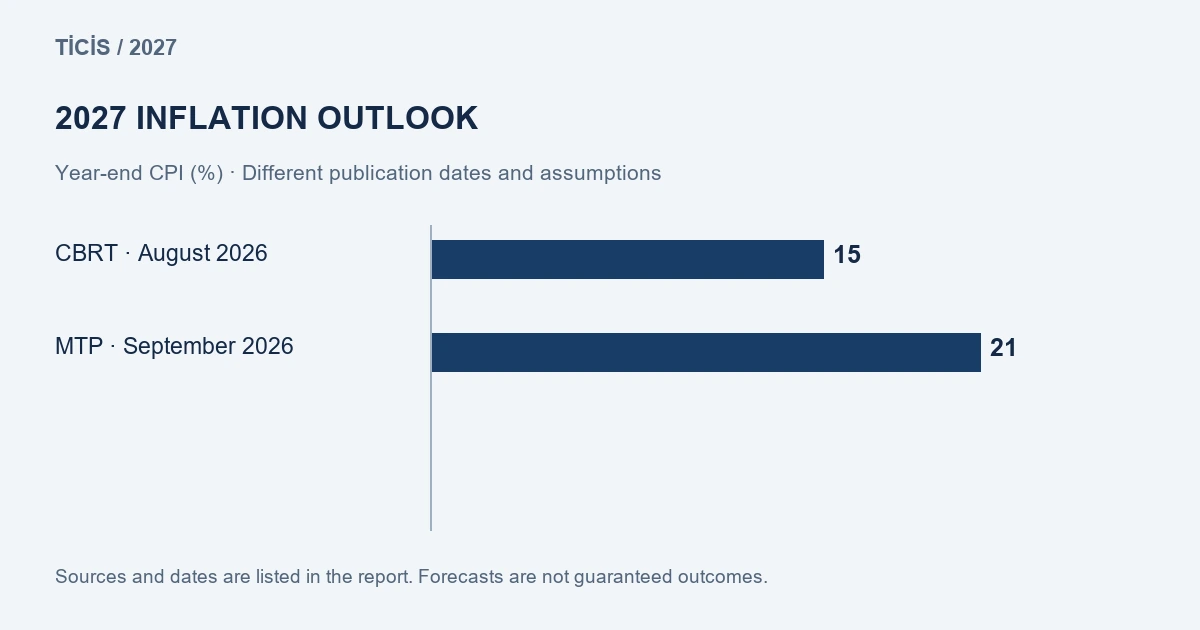
| CBRT, 13 August 2026 Inflation Report III presentation | Türkiye year-end CPI | %15 | Forecast based on monetary policy and other assumptions |
| SBB, 6 September 2026 Medium Term Program | Türkiye year-end CPI | %21 | Program goal |
| SBB, 6 September 2026 Medium Term Program | Türkiye real GDP growth | %4,2 | Program forecast |
| OECD, 3 June 2026 Economic Outlook | Türkiye real GDP growth | %3,8 | OECD estimate |
| IMF, 13 October 2026 World Economic Outlook | World real growth | %3,4 | Global forecast, not Türkiye forecast |
The dates, methods, and information sets of these estimates differ; Arithmetic averages do not produce a corporate estimate. CPI represents the household consumption basket; The increase in the company's energy, wages, rent or imported machinery basket does not have to be the same. The fact that annual inflation falls to a certain rate at the end of 2027 does not indicate that all costs will increase at that rate throughout the year.
Sources: CBRT presentation; SBB MTP press release, p. 5–6; OECD Türkiye outlook; IMF October 2026. This table should be updated when newer estimates are published.
2. Financing: from the world market to the enterprise's loan offer
Initial indicators: production, turnover and foreign trade should be read together
According to TurkStat, calendar-adjusted industrial production fell by 1.9% year on year in August 2026, while manufacturing output fell by 2.5%. In the same month, the total turnover index rose by 31.8% and industrial turnover by 32.6% year on year. These indicators measure different things: production reflects volume, whereas turnover reflects the monetary value of sales. Read together, they show that price and volume can diverge. Their difference cannot be interpreted directly as sector profit, inflation or sales-volume growth for all businesses. TURKSTAT industrial production · TURKSTAT turnover indices
The Ministry of Commerce announced September 2026 goods exports as 25.976 billion dollars and imports as 31.208 billion dollars. These are foreign trade values for a single month; It does not show trade in services or the entire current account balance. TİCİS assessment: the exporter must separately monitor his order quantity, price, country of delivery and collection; An increase in total exports does not mean an increase in every sector or every business. Ministry of Commerce
When evaluating credit supply, CBRT's Bank Loans Tendency Survey and commercial loan interest series should be followed along with the policy rate. The standards and demand results of the survey are the banks' evaluation; It is not a loan approval or specific interest guarantee for any business. The survey can be used to monitor credit standards and the direction of demand; This report does not generate a business-specific credit probability from the survey. CBRT data
The IMF's October 2026 Financial Stability Report monitors the rise in bond yields, vulnerabilities in private credit and cyber risks. When the cost of global funding increases, the cost and risk appetite of outsourcing banks may be affected; The reflection of this on credit in Türkiye is not direct or one-to-one. Country risk perception, bank balance sheet, regulations, collateral, loan maturity and customer financial situation change the outcome. Even if global interest rates fall, the loans of every business will not automatically become cheaper. IMF GFSR
When comparing loan offers, include allocation, commission, insurance, collateral cost, variable interest rate and early payment requirement in the total cash flow, as well as nominal interest. List usage and refund currency and date. A foreign currency loan is not cheap just because the interest rate is low; Exchange rate changes may increase the TL equivalent of the installments. If the foreign exchange proceeds do not match the currency and maturity of the loan, the natural hedge is missing. Evaluate the costs and risks of protection products with an independent expert.
Application: Enter the principal, interest and security obligations for the next 12 months into the monthly table. Calculate the cash gap in the scenario where loans are not renewed or are delayed. Check with banks before the deadline; Confirm the contractual conditions of the unused limit and whether it is actually usable.
3. Cash flow, price and purchasing power
The cash conversion period is approximately the stock-out day + the receivables collection day − the day of payment to the supplier. When this indicator is prolonged, working capital needs may increase even though sales increase. Since inventory and receivables days are calculated with average values, seasonal peaks should be monitored separately. When a 13-week weekly cash flow is used together with a monthly 12-month plan, short-term payment constraints become more visible.
Calculate gross margin by product and customer. Separate which product creates returns, discounts, freight, energy, wastage and financial expenses. While a large order whose collection is delayed may appear profitable on paper, it may create a cash deficit. Clearly regulate price updates, maturity, delivery and exchange risk sharing in contracts; Get a professional opinion for applicability.
Purchasing power parity is a statistical conversion tool that takes into account price differences of a comparable basket of goods and services across countries. It is not the market rate or future exchange rate that will be applied to a business's imported input. When choosing an investment location, in addition to local costs such as wages and rent, machinery, energy, taxes, logistics and financing costs to be paid at market rates should also be calculated. World Bank ICP methodology
4. Scenario design and sensitivity analysis
Shocks working together
Stress testing should not only change each variable individually. For example, a decrease in global risk appetite may extend the time it takes for the company to find a new loan and create volatility in foreign exchange and imported input costs. There is no guarantee that this relationship will occur or be of a certain magnitude. When shocks are used together in the model, they should not be counted twice: if you have already reflected the exchange rate increase in the imported input cost, do not add the same increase a second time as a general cost shock. Apply the loan interest increase only to the recurring or variable interest loan amount and the relevant period; Do not automatically reprice all fixed-rate debt.
A scenario card should include the initial period, the unit of the variable, the magnitude of the shock, the calculated amount, contract assumptions and out-of-scope elements. The combined effect of multiple factors is not always the same as adding up the worst outcomes alone: when volume decreases, volume-related expenses may also decrease. Which part of items such as stock, wages, rent and energy is fixed or variable should be determined from the business's own records.
Reality, exchange rate and maturity compatibility
Using nominal income change and price increase, the approximate real change is calculated as follows: (1 + nominal change) / (1 + price index change) − 1. For example, the combination of 30% nominal growth and 20% price increase corresponds to a real increase of approximately 8.3%. This depends on the assumption that the correct price index is chosen; The company's product price index and the general CPI do not have to be the same. The fact that revenue realization and collection fall on different dates may also create a need for cash.
In evaluating the foreign exchange open position, not only the total year-end debt and annual export revenue should be compared; Expected collections, debt installments and reliable hedging transactions in each currency and maturity should be matched. A temporary liquidity gap that may occur within a year may put a strain on the business, even if the year-end total appears balanced. Counterparty risk, hedging cost, available limit and contractual obligations should also be evaluated.
Use three scenarios: basic, current orders and verifiable cost assumptions; positive, improved sales and collections; stress, cost and financing pressures occur together with the weakening of demand. These are not prediction distributions or claims of probability of occurrence. Assign a responsible person, review date, and decision trigger to each scenario.
Example: Assuming sales of 10 million TL and variable expenses of 7 million TL, the contribution is 3 million TL. If sales fall by 10% and variable expense changes by the same rate as sales, the contribution is $2.7 million; It is assumed that fixed costs do not change. Simultaneously increasing the unit cost or changing the price also affects the result. This simplified example does not account for profit, tax, financing and cash flow.
For investment projects, include installation, training, maintenance, insurance and working capital in the initial expenditure. Test scenarios of sales delays, cost overruns and interest increases. In the net present value calculation, the discount rate and the currency of the cash flows and the inflation assumption must be consistent. Payback period alone does not explain project value or risk.
5. Sectors: Conditional assessments of TİCİS
Manufacturing and machinery
Reference data: In September 2026, the domestic producer price index increased by 27.38% annually and the manufacturing products index increased by 29.09%. This index does not mean that all expenses or profit margin of the business change at the same rate. TURKSTAT D-PPI
Outlook: Even if demand recovers, energy, financing and imported intermediate goods costs may pressure margins. The decision to increase capacity should take into account current capacity utilization and confirmed orders. Risk: The combination of exchange rate and delivery delay in machinery imports increases the investment cost. Watch: unit energy consumption, capacity utilization, order cancellation and inventory aging. 90 days: calculate contribution margin by product; Compare maintenance and energy efficiency investments with measurable savings. Calculate debt service in a low sales scenario for capacity investment with new debt.
Textiles and ready-made clothing
Outlook: Foreign market demand, customer purchasing decisions and competitive pricing are important. Wage and energy costs and delivery time should be evaluated together. Risk: dependence on few foreign buyers, increased cost in long-term ordering and seasonal product remaining in stock. Watch: order turnaround rate, wastage, collection period, customer concentration. 90 days: review net profit and cash conversion per customer; do not increase capacity based on non-guaranteed order expectations; Test product and market diversification with test orders.
Automotive and suppliers
Outlook: The order schedule and technology transformation of main manufacturers affect sub-suppliers differently. The demand for a part may vary depending on vehicle technology. Risk: Dependency on a single platform, return on mold investment depends on order volume. Watch: customer schedule changes, quality returns, machine utilization rate and contract renewals. 90 days: match turnover with investment risk by client and platform; Evaluate the cost of alternative manufacturing and engineering capabilities.
Agriculture and food
Reference data: August 2026 Agricultural Input Price Index increased by 30.28% annually, while the energy and lubricants subgroup increased by 43.14%. These indicators do not exactly represent the true cost basket of different products and businesses. TURKSTAT Agricultural Input Price Index
Outlook: Climate, water, energy, fertilizer and cold chain costs are reflected differently in sub-sectors. Risk: harvest and supply loss, spoilage, food price volatility and long collection periods. Watch: product yield, water consumption, wastage, stock period and producer prices. 90 days: evaluate alternative suppliers and storage capacity; review quality, traceability and food safety records; Verify insurance coverage with the relevant agency.
Retail and e-commerce
Current demand indicator: While TURKSTAT–CBRT consumer confidence index was 91.9 in September 2026, it decreased to 84.8 in October. The index measures survey expectations; It is not a sales forecast for the business. TİCİS comment: Weakening of trust requires careful monitoring of customer behavior, especially in products whose purchase can be postponed. Suggestion: Track sales quantity, average basket and cancellations separately; Do not use the confidence indicator alone for budget changes. TURKSTAT consumer confidence
Outlook: Purchasing power, product mix and customer traffic produce different results in different product groups. Risk: high stock, returns, marketplace commission and collection costs of installment sales. Watch: stock turnover rate, product-based net contribution, delivery cost per basket and return rate. 90 days: analyse inventory ageing; Evaluate campaigns based on net contribution and cash rather than turnover; Compare rent and personnel expenses to the low sales scenario.
Construction and real estate
Cost indicator: TURKSTAT's August 2026 construction cost index increased by 29.59% annually. The cost of a project may vary depending on its stage and material-labor distribution. TURKSTAT construction cost index
Baseline indicator: In August 2026, the construction production index increased by 2.3% annually, while building construction decreased by 0.9% and construction of non-building structures increased by 21.8%. These differences do not show the same results for every project or company. TURKSTAT construction production
Outlook: Financing conditions, license, land and input costs are decisive on the project scale. Risk: cost increase, sales or delivery delay and cash flow deterioration in fixed price commitment. Watch: actual cost, remaining work, pre-sales collection, permit schedule. 90 days: recalculate the cost of completion for each project; match progress and payment schedule; Review the legislation and contractual provisions with an expert.
Tourism and accommodation
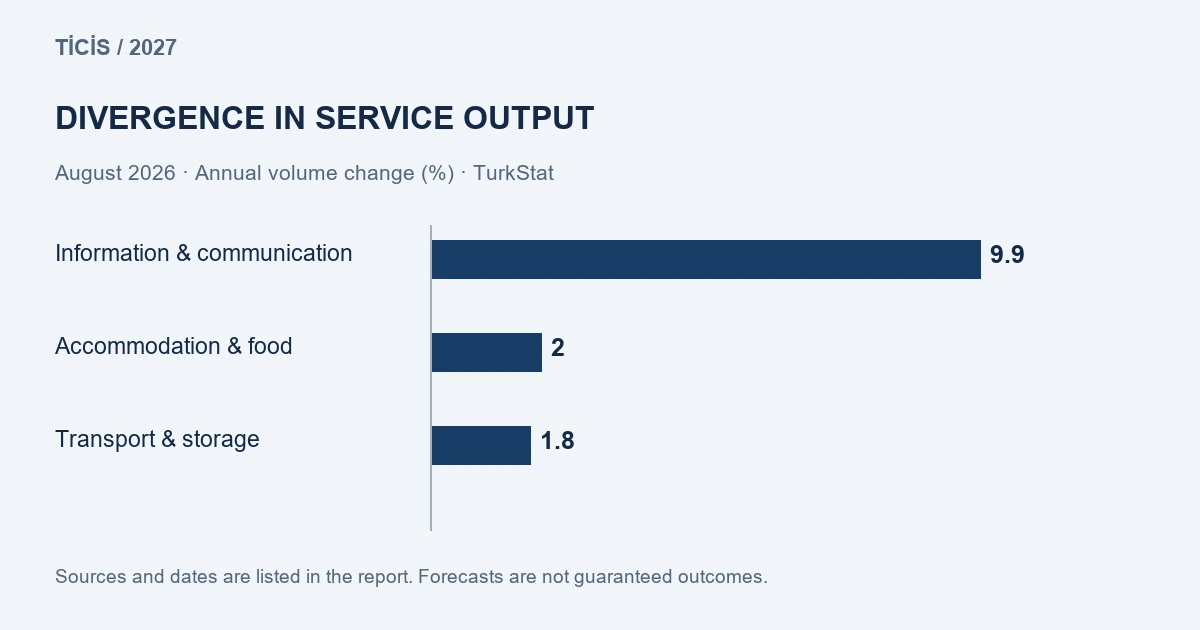
Baseline indicator: In the 15 October 2026 bulletin of TÜİK, the accommodation and food services production index increased by 2.0% annually in August. This volume indicator is not occupancy or profit per business. TURKSTAT service production
Outlook: Demand is broken down by country, season and booking channel; occupancy alone is not profitability. Risk: Foreign currency income not covering local cost increases, cancellation and distribution commissions. Watch: net room revenue, occupancy, cancellations, energy and personnel costs. 90 days: analyze net revenue by channel and customer country; plan for off-season cash reserves; Match energy and staffing needs to occupancy scenarios.
Logistics and transportation
Outlook: Fuel, foreign currency vehicle and maintenance expenses and trade volume are decisive. Risk: late adaptation of the freight price to the cost increase and empty return. Watch: occupancy, mileage cost, fuel, delay and customer payment collection per vehicle. 90 days: Calculate net contribution by transport route; review how fuel and exchange rates are reflected in contracts; Prepare alternative routes and supply plans.
Energy and renewable investment
Outlook: Production, consumption, grid connection and financing conditions determine the real value of the investment. Risk: project delay, production estimate deviation, equipment and interest cost. Watch: measured consumption profile, connection and permitting processes, maintenance expense and financing term. 90 days: test feasibility with hourly consumption and conservative production assumptions; Verify permit, incentive and offset conditions from up-to-date official sources.
Technology, software and artificial intelligence
Baseline indicator: The August 2026 information and communication services production index increased by 9.9% annually. The index cannot be interpreted as the increase in turnover, profit or software exports of all technology companies. TURKSTAT service production
Outlook: Automation can offer an opportunity for efficiency; The success of the technology depends on its use and process design. Risk: foreign currency infrastructure cost, data leakage, erroneous outputs and supplier dependency. Watch: net revenue per customer, cloud cost, renewal rate, and security incidents. 90 days: identify small scope pilot; establish human control, data access authorization, and security testing; Verify project returns with time and quality measurement.
Health and medical products
Outlook: Regulation, quality, imported input and payment time are important for products and services. Risk: supply interruption, exchange rate impact, changes in permit and reimbursement requirements. Watch: critical stock days, lead time, collection and quality indicators. 90 days: review alternative procurement and records for critical products; Verify the permit and application conditions from competent institutions and experts.
Export and international trade
Outlook: Market growth alone does not guarantee company orders; The importer's cost and compliance demands may affect the price. Risk: collection, exchange rate, protectionism, transport disruption and dependence on a single market. Watch: country and customer concentration, order cancellation, collection day, customs classification. 90 days: review customer verification and contract risk; Determine whether EU regulations apply according to the commodity code. For products falling within the scope of CBAM, separate the EU importer's obligations from the manufacturer's data preparation. European Commission
Small businesses and services
Outlook: Local demand, rent, personnel and collection structure often produce faster results than the macro indicator. Risk: mixing of personal and business cash, failure to update prices based on cost, and dependence on a small number of customers. Watch: weekly cash, contribution per product, repeat customer and rent/turnover ratio. 90 days: separate work and personal accounts; list the most important expenses; Create a cash plan and customer loss scenario for critical payments.
6. Checklist for the board of directors
Sample stress tests — not hypothetical, probability or prediction
Manufacturing / energy: Let's assume that the annual energy expenditure is 4 million TL and the production, efficiency and consumption amount are constant. A 20% increase in unit energy price increases the annual cost by 800 thousand TL for the same consumption. If the company can transfer half of the cost increase to the sales price, everything else being equal, the uncovered amount will be 400 thousand TL. The actual outcome depends on contract and demand elasticity; changing volume and taxes are not included in this example.
Tourism / capacity: Let a facility with 100 rooms operate for 180 days. If occupancy decreases from 70% to 60%, the number of rooms sold decreases from 12,600 to 10,800. Assuming net income per room is 3,000 TL and the price remains unchanged, the difference is 5.4 million TL. This amount is not a loss of profit: the reduction in variable expenses of vacant rooms, other income and fixed expenses should be evaluated separately.
Export/collection: In annual forward sales of 36 million TL, assuming that sales are distributed evenly throughout the year and the collection period increases from 30 days to 45 days, additional receivables financing is approximately 36 million / 365 × 15 = 1.48 million TL. This approximate calculation assumes that sales and receivables formation occur at the same timing; VAT, seasonality and non-collection risk are excluded. The annual financing cost of this amount must be determined separately based on the actual interest to be applied and the duration.
Foreign currency debt: If the exchange rate for a 100,000 USD open debt increases from 40 TL to 44 TL, the TL equivalent increases from 4 million TL to 4.4 million TL, without any other factors changing. These figures are just examples; It is not an exchange rate estimate. Income or hedging transactions to be collected in the same maturity and currency may change the net effect.
1. Are the 13-week cash plan, the next 12 months' debt calendar and alternative sources ready?
2. Are the collection risks, contracts and share of the five largest customers in total sales known?
3. Are foreign exchange income and foreign exchange liabilities matched by currency and maturity?
4. Net contribution per product and customer; Is it measured including wastage, returns, freight and commission?
5. Can investments be sustained in scenarios of delay, low demand and cost increase?
6. Has a person been appointed responsible for human resources, cyber security, supply continuity and regulatory changes?
7. Source and method limits
This report uses public releases and conditional analyzes from TİCİS accessed as of October 28, 2026. Sector segments are not econometric sector growth forecasts; These are sample risk and action areas. The exact magnitude of causal effects between global financial conditions and a single company's credit offer has not been calculated. Differences between sectors, as well as company scale, contracts and regional conditions, alter the results. Data and legislation may be updated; The date and validity must be reconfirmed before the decision.
8. TİCİS 2027 decision framework: making growth financeable
An optimistic expectation does not mean that all businesses will grow at the same time and at the same pace. TİCİS's opportunity-focused approach begins by asking what advantage the business can measure and with what resources it will grow that advantage. Whether a manufacturer shortens delivery time, a hotel increases its direct booking rate, or a software company reduces customer churn can create value regardless of macroeconomic conditions. Therefore, in the 2027 plan, efficiency areas that the management can control should be determined instead of relying only on external improvement.
The first decision is the definition of growth. Sales amount, quantity sold, gross contribution, operating result and operating cash are separate targets. When management makes just one of these the measure of success, unexpected incentives can arise. Evaluating the sales team solely by turnover can increase long-term and low-contribution orders. Measuring the purchasing team solely by unit price can hide high inventory and quality issues. If the finance team focuses only on short-term cash preservation, it may lead to postponement of necessary maintenance and training investments. The common goal is to make visible the decisions that increase the sustainable value of the business.
The TİCİS proposal is to manage the 2027 budget with three separate views. Business view includes order, price, quantity and customer mix; operational view includes production, supply, quality and human resources; The financial outlook should include cash, debt, exchange rate and investment schedule. The same assumption should not be used differently in different tables. If the sales budget assumes growth with a new customer, the production plan continues with current capacity, and the cash plan assumes that the customer will pay an advance, there is not a single budget but three separate expectations that do not support each other. At the assumptions meeting, these inconsistencies should be resolved before a decision is made.
The purpose of the monthly meeting for the board or business owner is not to discuss every number. First, the three largest deviations should be determined, and then it should be differentiated whether the deviation is due to price, volume, efficiency, schedule or collection. For each significant deviation, the responsible person, corrective action, completion date and remeasurement method should be identified. Optimism is strengthened not by removing problems from the report, but by expanding the company's field of action by seeing correctable problems in a timely manner.
9. The credit committee's view: moving the case from narrative to evidence
A business's financing request should be able to describe the source of reimbursement for the purpose of use in the same sentence. It should be concretized which orders the loan requested for stock purchase serves, when the machinery investment will start operating and from which customers the receivable financing will be collected. If the financing request only shows the size of the cash need, the most important question of the bank or investor remains unanswered: As a result of what activity and on what date will this resource return?
The TİCİS recommendation is to add a presumption sheet to the financing dossier. In the table, sales volume, average sales price, unit cost, collection day, stock day, supplier maturity, investment payments and debt installments are shown over the same periods. The basis for each assumption is stated: current contract, quote, past realization, customer conversation or management scenario. The binding order and the possible order are marked separately. Thus, the well-intentioned but not yet confirmed growth expectation is not presented as a certain collection.
Offers must be on the same basis to compare financing terms. One bank's annual rate and another's monthly rate cannot be placed directly side by side. Deducting commissions initially may reduce the net amount available. A grace period may not mean no interest will accrue. It is also an economic cost that the guarantee closes other financing channels to the business. Therefore, comparing payment plans using actual cash inflows and outflows is more meaningful than simply comparing the rates in the ad or offer headline.
Credit rejection or limit reduction should not be attributed to a single reason. The bank's sector preference, its own balance sheet constraints, collateral structure, the company's financial data and the requested maturity may be effective at the same time. The useful question from a business perspective is which element is replaceable. A shorter investment phase, additional equity, customer advances, purchasing in line with supplier schedules or better reporting can create different solutions. None of these are a guarantee of credit approval; The aim is to carry out the financing conversation with concrete options.
10. Cash management: reading the weekly and monthly plan together

A business that appears to be profitable annually may experience a liquidity crunch during the year. Therefore, a 13-week cash plan and a 12-month budget are not alternatives to each other. The weekly plan includes near-term salary, taxes, supplier and debt payments; The monthly plan shows seasonality, investment and financing needs. The first weeks of the plan should be prepared in detail close to reality, and the distant weeks should be prepared with clearly stated assumptions. By comparing actual and planned collections each week, the reliability of the following weeks is re-evaluated.
Collection forecasting becomes more useful when it starts at the customer and invoice level. Counting all amounts due but not collected as cash inflows next week only carries the problem to the next period. The customer's payment behavior, disputes, refund requests and acceptance conditions in the contract must be taken into account. Purchasing and production teams should also be notified when major customers' payment schedule changes; Information carried by the finance department alone is not reflected in operational decisions in a timely manner.
The decision to reduce stock should also be selective. The rate at which each stock is converted into cash and its role in production continuity are not the same. A low turnover rate of a critical spare part does not necessarily mean that it is unnecessary; its absence may cause production to stop. On the other hand, keeping seasonal products with low sales probability in stock at high values creates both financing and value loss risks. The TİCİS recommendation is to evaluate stocks by operational groups such as critical supply, regular sales, slow movement and obsolescence risk.
It is not correct to recommend a single number of months for cash reserves that can be applied to every company. Fixed expenses, collection volatility, access to financing, seasonality and supply obligations are different. The business must calculate how long it can meet its critical payments in a stress scenario. An unused credit line should only be considered a supporting resource when its terms and availability are confirmed. In addition to being a forecast table, the cash plan is an early warning tool that shows which decision the management will make on which date.
11. Pricing: separating sales growth from value creation
The price decision is not as simple as transferring the cost increase to the customer. Customer alternatives, product differentiation, delivery reliability, contract duration and capacity in the market affect pricing power. TİCİS's optimistic assessment is that businesses that measurably improve quality and service can deliver value without relying on price competition alone. This is not a guarantee of a price increase; It requires researching how much the customer values which feature.
While preparing the product-based contribution table, only raw materials should not be deducted from the sales price. The portion of channel commission, packaging, delivery, returns, special packaging, customer service and collection costs that can be charged to the relevant product should also be visible. It is possible for the same product to create different contributions in different channels. Just because the campaign increases sales does not mean it increases total contribution. The additional operation and financing needs of the increased volume after the discount should be evaluated separately.
The price elasticity assumption can be tested in small experiments. Rather than implementing a major change to all customers at the same time, results can be monitored by product, package or service option in an appropriate and legal commercial order. The criterion of success should not only be conversion rate, but returns, customer satisfaction, repurchase and net contribution. Universal conclusions should not be drawn from a single trial as results may be affected by season, campaign, competitor behavior or customer mix.
Leaving the price change mechanism unclear in long-term contracts may increase the risk of disputes. Which index, which date and which calculation method will be used should be clarified between the parties. A macro index may not fully represent the true cost of the product. For this reason, commercial preparation and legal applicability of the contract should be considered as separate areas of expertise. This report does not provide legal opinion on the validity of any particular provision.
12. Investment decisions: capacity, efficiency and flexibility

Investment projects should not be put in the same category. Capacity expansion can serve the need for more sales, efficiency investment can serve measurable savings in current production, compliance investment can serve the maintenance of operating conditions, and maintenance investment can serve reliability. The success criteria for each project are different. While capacity investment can remain idle when sales growth lags, well-chosen maintenance investment can help fill existing orders more reliably by reducing downtime.
The TİCİS proposal is to also calculate the no-investment option for each investment. What are the maintenance, quality, energy and capacity limits of continuing with existing equipment? Is rental, contract manufacturing, phased installation or another supply arrangement possible? Alternatives should be compared within the same product quality, delivery schedule and risk framework. The lowest initial payment does not mean the lowest total cost of ownership; Installation, licensing, spare parts and exit costs should also be taken into account.
The payback period of the investment is an easily understood but limited indicator. It alone does not explain post-repayment cash flows, time value of money and project risk. Net present value helps compare cash at different dates with a consistent discount rate. However, the precision of the calculation result depends on the sales, cost, investment amount and discount assumptions used. Presenting a sensitivity table instead of a single seemingly certain result creates a healthier decision basis.
When uncertainty is high, incremental investment can provide learning opportunities. A pilot capacity or limited product group is tried first; technical efficiency, quality and customer demand are measured; For larger expenditure, predetermined conditions are required. This method cannot be applied to every project and the unit cost of small scale may be high. Nevertheless, it is valuable in terms of clarifying the information with which irreversible decisions will be made. TİCİS's opportunity-focused approach is to advance investment in the correct order and with verifiable justification, rather than delaying or accelerating investment.
13. Workforce, competence and automation
The workforce plan does not only consist of the number of employees. New product, export market or machinery investment may require different skills. The business must determine critical tasks, the number of people who can perform these tasks, and the status of information transfer. It is a significant continuity risk if production, sales or financial operations cease in the absence of a person. Process documentation and cross-training can increase resilience without major technology investments.
The starting question in an automation project is not which task to eliminate, but which process to improve and to what extent. Repetitive data entry, error checking, production planning or classification of customer requests require different technical solutions. The benefit of automation cannot be reliably calculated without measuring errors and waiting times in the current process. Before pilot implementation, the reference period, data quality and success criteria should be determined.
Artificial intelligence outputs should not be automatically accepted as correct, especially in financial, legal, healthcare or personnel decisions. The business must determine what data is sent to which service, who has access to it, and who controls the results. Data management, service continuity, model changes and exit opportunities should also be evaluated as well as the supplier's price. The TİCİS comment states that technology investment does not reduce corporate liability; When designed correctly, it can help employees focus on more qualified work.
The training budget should also be tied to measurable targets. At the end of the training, it can be determined which operation will be done more accurately or faster and which security or quality problem will be reduced. Certificate of participation alone may not indicate that competence has been achieved. Transfer of learning to activity should be monitored through on-the-job practice, feedback and remeasurement. The optimistic opportunity for 2027 is to design people and technology to increase productivity together, rather than seeing them as alternatives to each other.
14. Industry dossiers: turning expectation into business decision
The evaluations in this section are TİCİS's conditional business analysis. It does not include any commitment to sales, profitability or return on investment for the entire industry. The results of companies exporting, working in the domestic market, growing with debt or equity in the same sector may differ. Each file explains through which mechanism the opportunity may arise, which indicator to monitor and what decision management can prepare. Our optimism is not based on the assumption that demand will increase on its own; It is based on measurable efficiency, better customer selection and disciplined use of capital.
Manufacturing: efficiency from order to delivery
The beginning of 2027 preparation for the manufacturing company is not to increase production capacity, but to understand how much of the existing capacity it can sell on time and with acceptable quality. The operation of the machine alone does not create value. If a significant part of the production time is spent changing settings, waiting for quality control or searching for materials, the new machine may magnify the same irregularity. TİCİS considers that gradual investment can yield stronger results at manufacturers whose order flow is visible and bottlenecks are measured.
Management must track quote-to-order conversion, delivery reliability, right-first-time production rate, rework hours, and contribution per machine for each product family. Average capacity utilization can hide the capacity of the critical line. A single coating or testing station can delay all deliveries while total capacity at a facility appears empty. In such a case, bottleneck improvement instead of general capacity increase may yield results with less capital. This evaluation should be made with customer deadlines and actual production data.
In the optimistic scenario, a shorter delivery time reduces the customer's safety stock need and differentiates the supplier with features other than price. However, it should be monitored whether this advantage is reflected in the sales price or repeat orders. If free acceleration becomes permanent, the manufacturer may be taking over the customer's inventory financing. It is important that standard delivery, urgent delivery, design change and cancellation conditions are priced separately in the contract.
The TİCİS proposal is to conduct a pilot study in the first quarter that shortens the delivery time on a single product family. The criterion of success should not only be unit cost reduction; The total cost and the contribution collected per intact product delivered should be evaluated. The investment decision should only be magnified when the lasting outcome of the pilot, maintenance capacity and order visibility are verified together. Thus, the 2027 budget turns from an abstract desire for growth to a concrete production gain.
Textiles: product mix and short-run economics
The same turnover in textile and ready-made clothing can create very different cash results in different product mixes. An order with a long lead time, requiring high stock and requiring frequent design changes is not equivalent to an order delivered in a short time using standard fabric. When labor, energy, accessories, samples, wastage and financing are monitored separately, it can be seen why a nominally high-priced job produces low contribution. The approach that TİCİS sees positive room for 2027 is reliable delivery and specialization in the right product group, rather than competing only with low prices.
The business's order evaluation should be made on a customer basis. Sample approval time, order cancellation history, return reason, payment behavior and reorder possibility should be considered together. If the design development cost constantly remains on the manufacturer, it should be clear how this is reflected in the bid price. Dependence on a high-volume customer can reduce bargaining power while streamlining production scheduling. New customer acquisition is therefore not only a sales target but also a means of balancing risk.
In stock management, fabrics and accessories that can be used in common and customer-specific materials should be separated. While general purpose material can be evaluated in another order, special printed product may lose value in case of cancellation. For customer-specific material, advance payment, approval phase and cancellation fee should be considered. These decisions are shaped by experts within the framework of the contract and customer relationship; It should not be assumed that the same condition will be accepted in every market.
TİCİS proposal is to review the 2027 collection and capacity plan based on collected contribution on a customer basis. If the fast delivery advantage is to be used, the supplier must also adapt to the same speed. Delaying the critical accessory can negate the entire advantage. Specializing in fewer but correct product families, reducing sample load and commonizing order data; These are concrete improvements that can be evaluated before an expensive capacity investment.
Automotive: modular investment in transformation
Preparation for 2027 in the automotive supplier industry is a matter of adapting to changing product architecture while maintaining existing customer programs. It is not right for every business to invest in the same technology, at the same speed and in the same size. When entering a new part group, engineering capability, quality system, testing need, customer approval and mass production volume should be evaluated together. TİCİS believes that suppliers who divide the transformation into phases can be better positioned to both capture opportunities and preserve capital.
Management should monitor the remaining contract period on a program basis, the difference between the projected volume and the actual call, the recovery of the mold investment and the cost of quality. The customer's volume estimate may not be a definitive purchase commitment. When investing in special equipment, it should be clarified who will bear the volume reduction, schedule delay and design change. The ability to use the same equipment for different customers or product groups creates significant option value in the face of uncertainty.
In the optimistic scenario, engineering service, traceable production and fast problem-solving ability can enable relationship building beyond price competition. However, quality success alone is not cash success. Warranty interruptions, measurement discrepancies and long payment terms must be factored into the economics of the offer. The performance table must include accepted invoices and collected revenue as well as the shipment amount.
The TİCİS proposal is to divide new technology investment into separate decision gates: sample, validation and mass production. Budget, technical acceptance and customer demand are re-evaluated at each door. Rather than a major investment being approved all at once, evidence that merits moving to the next stage is identified. This discipline does not mean staying away from innovation; It ensures that the resources allocated for innovation are directed to the right product at the right time.
Agriculture and food: yield, wastage and cold chain
Opportunity evaluation in Agriculture and food will be incomplete if it focuses only on product prices. Harvest efficiency, quality class, storage loss, packaging, energy, transportation and collection together determine the operating result. The portion of the same tonnage product available for sale may vary. The area that TİCİS considers positive for 2027 is obtaining more salable value from current production. Investment that reduces wastage, extends shelf life and increases delivery reliability; can contribute without expanding capacity.
The producer and processor must match the input quantity to the salable output quantity on a batch basis. Where does loss occur: in receiving, in processing, in storage, in distribution? It is not enough to set a general efficiency target without knowing the cause of the loss. Finding a device for the cold chain and ensuring temperature continuity are different. Malfunctions, power outages, loading delays and deviations during transportation should be recorded.
Product and customer mix is important against price volatility. Dependence on a single product or a single buyer can magnify cash volatility in the following period, even if it provides high profits in a good season. Processed product, contract supply or different sales channel options should be evaluated according to the skills of the business. It should not be forgotten that each new channel has returns, shelf fees, commission and collection costs. A higher shelf price does not necessarily mean a higher net income for the manufacturer.
The TİCİS proposal is to set separate targets for salable yield and waste reduction in the 2027 budget, instead of increasing the sales price alone. Agricultural input and product price indices can show the general direction; The real cost of the business is measured by its bill of materials and purchase time. When evaluating water, energy and storage investments, technical savings claims should be tested with actual usage hours. Thus, resource efficiency turns into a measurable opportunity in terms of both cost and continuity.
Retail: from turnover to basket contribution
In retail and e-commerce, a high number of orders does not alone prove a successful business model. The remaining contribution after deducting discounts, commissions, shipping, payment costs, returns, packaging and customer acquisition expenses should be monitored. TİCİS's positive approach for 2027 is that businesses that retain customers not with more campaigns but with more accurate products, reliable delivery and consistent service can grow more resiliently. This approach should be measured on a channel-by-channel basis.
Management should consider the economics of the same product in the store, on its own website and in the marketplace separately. Invisible service and financing costs should be taken into account when comparing prices between channels. The fact that marketplace sales appear high does not mean that collection is early or that the customer relationship belongs to the business. When channel dependency increases, commission changes and loss of visibility can have a greater impact on the budget.
Inventory turnover rate should be compared between product groups. A fast-turning low-margin product may produce better cash results than a slow-turning high-margin product. However, too low stock may also cause loss of sales and customers switching to another brand. The decision is not to reduce the stock day per se; To reduce unnecessary capital commitment while maintaining the service level. The relationship of the return reasons to the product description, size information or transportation damage should be examined separately.
The TİCİS proposal is to include contribution per order, repurchase and net sales after returns measures next to the gross turnover target in the 2027 campaign approval. The recovery period of the expenditure made to the new customer should be calculated with past orders; Repeat purchases that have not yet occurred should not be considered as definitive income. The optimistic growth scenario can be set up with lower returns and better customer experience before higher advertising budget. These improvements support both cash and brand trust.
Construction: project cash and phased commitment
In construction and real estate, the company's overall profitability should be differentiated from the cash needs of a single project. Progress payment timing, advance payment, guarantee, subcontractor payment, material purchase and sales collection do not occur on the same calendar. In preparation for 2027, TİCİS recommends paying attention to the visibility of project financing before project size. The optimistic scenario should include an increase in business volume as well as an improvement in collection order and enforcement discipline.
For each project, the amount of work remaining, the cost required to complete, and the expected collections must be recalculated. A contract that seemed profitable in the past may differ when material or labor costs rise. If the budget update only looks at the amount spent, it will miss future cost pressure. The impact of the delay in the work schedule on site general expenses, equipment rental and financing costs should be shown separately. This approach increases management's room for action before real damage occurs.
Project changes originating from the customer or employer should not be left with verbal agreement. The scope, price, time impact and approval mechanism of the additional work should be clarified. Legal terms are evaluated by the expert according to the concrete contract. The business recommendation here is that work done but not documented should not be used as final collection in the cash plan. Likewise, the expected new project should not be the only source of repayment of existing debts.
The TİCİS proposal is to monitor together project concentration and cash shortfalls in the 2027 portfolio. The fact that three separate projects require material payments in the same month may create risks at the company level. A decision that seems positive on a project basis may strain the company's overall liquidity. Staged contracting, controlled stock purchase and realistic delivery schedule; makes growth more manageable. For a capacity increase, the completion cost and financing must first be visible.
Tourism: occupancy, price and guest contribution
Although the occupancy rate is important in the tourism business, it is not an indicator of success on its own. Room price, channel commission, food and beverage costs, energy, personnel and cancellation conditions change the result. The same occupancy may create different contributions for different customer groups. TİCİS's positive assessment for 2027 is that businesses that balance the season, improve repeat visits and direct bookings, rather than growing demand only in the peak season, can improve the quality of revenue.
Management should separate revenue per room from contribution per room. As the services provided within the package increase, the cost may increase without increasing the gross income. There is a period of time between the price received in early booking and the cost on the date the service is provided. Therefore, contract currency, supply prices and working capital needs should be evaluated together. Making sales in foreign currency does not automatically eliminate all cost risks.
Cancellation and booking behavior should be tracked by date, country, channel and customer type. The reservation total that seems high should not be considered as absolute occupancy without taking into account the cancellation rate. When diversifying channels, it should be taken into account that direct sales also costs advertising, payment infrastructure and customer service. The aim is not to idealize a single channel; is to establish a balance between cost, control and demand.
The TİCİS proposal is to prepare the 2027 budget with monthly occupancy and price assumptions as well as variable cost per guest. Energy saving, maintenance and service standard projects should be tested before the busy season begins. Staff training can be tied to measurable goals not just for satisfaction scores but to reduce service duplication and operational loss. Optimistic growth comes from being able to provide more consistent service to the same visitors as well as more visitors. This approach can create a business advantage that reduces price competition.
Logistics: full mileage and contract quality
In logistics, fleet size alone does not indicate the true efficiency of the business. Full mileage rate, empty return, waiting time, maintenance, fuel, driver plan and collection should be evaluated together. The area that TİCİS sees positively for 2027 is to reduce the cost per unit service by better planning the existing transport capacity. New vehicle investment may increase the financial burden if made without understanding the loss of use in the existing fleet.
Loading and unloading waits should be visible when pricing on a customer basis. Although the mileage-based price seems reasonable, the vehicle may make fewer trips due to long waiting times. The contract should explain how waiting, additional stops, return load and extraordinary services are charged. The uncertainty of these issues can turn price competition into cost transfer. The business must see which customer uses the capacity and how, with its own data.
It should not be assumed that the total transportation cost will change at the same rate as the fuel cost changes. The share of fuel varies according to route, vehicle, load and usage type. Additionally, maintenance and financing costs arise at other times. When evaluating the advantage of a foreign currency contract, foreign currency debt, spare parts and cross-border costs should be calculated together. Net currency position cannot be understood by looking at gross foreign currency income.
The TİCİS proposal is to evaluate the 2027 route plan on contribution per trip and contribution per vehicle day. Digital tracking systems should be used not only to show location, but also to compare the cause of delay and the planned and actual cost. In the optimistic scenario, better matching, fewer empty returns and collection discipline produce more economic value with the same fleet. New capacity should then be supported by sustainable contract visibility.
Energy: investment appropriate to consumption profile
Installed power alone is not sufficient in energy and renewable investment evaluation. The consumption hours of the business, production profile, connection conditions, maintenance, financing and technical limitations in application should be examined together. In preparation for 2027, TİCİS does not see energy efficiency and energy production as alternatives to each other. First understanding where and why consumption occurs, then choosing the appropriate solution can create a healthier investment sequence.
The savings account should not have a single multiplication that considers the past bill as fixed. When production volume, working hours, weather conditions and product mix change, consumption also changes. Comparison before and after investment should be made at a similar level of activity. Otherwise, decreasing energy consumption as production decreases can be considered the success of the investment. The measurement plan should be determined before the project begins; Appropriate data may not be available later.
In a renewable project, the commissioning schedule and the date when income or savings will begin are as important as the investment amount. Technical suitability, permits, connection and contract conditions are verified for the concrete project. The report does not assume that any business qualifies for support or a particular selling price. Items such as maintenance and performance loss should not be forgotten in the financial calculation. Comparing offers within the same scope also increases decision quality.
The TİCİS proposal is to establish the 2027 energy budget in three layers: reducing unnecessary consumption, improving process efficiency and appropriate production investment. The optimistic scenario is that these three layers work together. Information gained through metering and small improvements before a major project can prevent incorrect sizing of the investment later on. Success is not just about bill reduction; The energy per production should be evaluated against continuity of maintenance and the actual cash contribution of the investment.
Technology: from automation to verified acquisition
The 2027 opportunity for technology, software and AI businesses is not to get the customer to use a complex tool, but to improve a measurable business outcome. Examples of these results might include shorter processing time, fewer errors, better demand planning, or faster customer response. The positive approach of TİCİS is that companies that engage the customer in the daily process rather than flashy presentation of the solution can develop more permanent income.
The software company should track the contract amount and the recurring revenue collected separately. The cost of installation service, licensing, maintenance and customer support varies. Making lots of customizations may make initial sales easier, but the cost of maintaining and re-releasing the product may increase. It should be clearly managed which features are common product parts and which are paid projects. Customer churn and contract renewal are as important as gross sales.
In artificial intelligence projects, data quality, access authority, human control and fallback plan in case of error should be evaluated. The accuracy of automatic outputs is tested according to the intended use. The consequences of a wrong marketing outline and a wrong production instruction are not the same. The average success of the model does not mean that critical error is acceptable. Accountability and control design should be part of the solution from the very beginning.
TİCİS recommends making the verified benefits delivered to each customer visible in the 2027 product roadmap. Record a baseline before the pilot and compare results afterwards under the same workload. If the benefits are confirmed, expand deployment. This helps buyers assess investments and links the seller’s price to demonstrable value. The optimistic scenario is not the complete automation of every process, but the expansion of reliable automation in suitable processes.
Health and medical: service growing with quality
2027 planning in health and medical businesses should consider commercial growth and service quality together. Reliability of the product or service, traceability, supply continuity and the need for competent personnel are at the center of the business model. TİCİS's positive assessment is that growth built on reliable process and specialization can be more durable than short-term volume racing. This section is not a clinical guide or evaluation of suitability for a particular product.
The medical supplier must monitor stock age, expiration date, service obligation, warranty and spare parts needs on a product-by-product basis. If the subsequent maintenance burden of a device with a high sales price is not taken into account, the actual contribution may be seen as inaccurate. Imported supply should be evaluated in terms of delivery time and technical compliance as well as exchange rate movements. There should be no gap between the commitment given to the customer and the commitment received from the manufacturer.
Increasing capacity utilization in a service business is meaningful if personnel and process quality are maintained to the same extent. Appointment, waiting, cancellation, re-transaction and collection data can be examined together. Commercial objectives should not undermine critical quality controls. Data access and record security is a management responsibility, not just a technical team issue. Concrete legislation and permit requirements should be verified with competent experts according to the type of activity.
The TİCİS proposal is to include a service capacity, maintenance and personnel plan in the 2027 investment file, along with the sales expectation. Demand forecasting alone is not enough for a new device or branch; The capacity to operate, maintain quality and meet cash needs must be demonstrated. The optimistic scenario is that reliable service creates repeat preference and corporate relationships. The growth step should be taken as fast as this service standard can be maintained.
Exports: the real cost of market diversification
Selling to a new country is an important opportunity in export, but the cost of the new market is not limited to the first order. Certification, product adaptation, distributor relationship, logistics, collection and after-sales service should be budgeted. TİCİS's positive approach for 2027 is to manage the cost of learning, starting from markets close to current competence. Rather than distributing to multiple markets at the same time, moving forward through verified demand and channels can provide more controlled growth.
The exporter must read the offer along with the delivery method, currency, payment condition and scope of liability. Different offers should not be compared solely on unit price. Whoever is responsible for transportation, insurance, customs process or after-sales changes the total economy. Concrete contracts and foreign trade transactions require expert review. The recommendation here is that uncertain costs should not be left invisible.
The idea that an increase in exchange rate provides profit to the exporter in any case is incomplete. Factors such as imported input, foreign currency debt, foreign currency commission and energy may reduce the effects. In addition, foreign customers can turn the exchange rate movement into a price reduction request. Management must derive the net foreign exchange position by currency and maturity. Having income and expenses in foreign currency within the same year does not completely cover the cash risk if they occur in different months.
The TİCİS proposal is to increase the number of customers in the 2027 market plan, as well as monitor the time to first collection and the cost of service per country. The purpose of the pilot order is not just to make sales, but to test the acceptance of the product and the collection process. After a successful pilot, investment in stock, personnel or distributors can be increased. The optimistic scenario is to establish a customer network that is more diverse, has strong payment discipline and repeat orders, rather than writing more country names.
Small businesses: simple registration, strong decision
Advanced management for small businesses doesn't necessarily require expensive software or a large finance team. Keeping regular sales, collections, cost and inventory records can improve many critical decisions. The positive assessment of TİCİS for 2027 is that the business working with the owner's information makes this information visible and transferable. This way, decisions don't rely solely on memory or the daily cash balance.
The business owner must separate personal expenses and business cash; He must see how much of the money in the cash register is allocated to taxes, suppliers, fees or debt payments. Today's high balance may not be a free resource due to liabilities in the near future. A weekly collection and payment list can provide earlier warning than a complex model. Finalized transactions and expected sales should be marked separately in the list.
In a service business, the collected contribution as well as the hourly income can be monitored. Tasks that take a lot of time but leave little contribution can consume capacity. Quotation preparation, revision, transportation and customer support are also included in the service period. When unpaid additional work becomes permanent, the apparent price and real hourly earnings diverge. Writing the service scope clearly from the beginning supports both customer satisfaction and business efficiency.
The TİCİS proposal is to classify the business's best-selling products or services at the beginning of 2027 by contribution, collection period and workload. The first improvement may not necessarily be opening a new branch; This may be to correct mispriced service, reduce product backlog or follow up on overdue collection. Optimistic growth arises from first making the existing business healthy. Regular registration helps manage a small business better, not make it look bigger.
15. From global credit terms to the business's credit offer
Improvement in global interest rates or risk perception does not mean that Turkish businesses will find loans with lower interest rates on the same day. The transmission chain includes international funding, country risk, the bank's resource structure, local monetary policy, regulations and the borrower's own characteristics. The optimistic framework of TİCİS is that a possible improvement in the external financing environment could increase options for well-prepared businesses. This framework does not include exact credit costs or access guarantees. The most useful preparation management can make is to prepare its credit file for this opportunity.
While a bank's resource cost decreases, the offer it makes to the business may not decrease to the same extent. Because credit risk, collateral quality, maturity and capital use are other parts of the offer. If the company's collections have deteriorated or its indebtedness has increased, the general improvement may be balanced by the deterioration specific to the company. Conversely, the company that better documents its cash flow and establishes the debt maturity in line with the cash production of the investment can negotiate more strongly within the same market. Therefore, it is incomplete to see the loan negotiation only as interest negotiation.
When comparing offers, the available net amount, principal payment plan, interest calculation method, commission, compulsory by-product and collateral conditions should be written separately. The cost deducted at the beginning differentiates the nominal loan amount and the cash received by the business. The short-term low interest advantage may be more expensive than expected in total due to early repayment or heavy collateral conditions. Placing different futures offers directly side by side is also misleading. The real comparison is made on the conditions under which they meet the same cash needs.
The seemingly low interest rate in foreign currency financing does not correspond to exchange rate risk. The solvency ability of a business whose income is in another currency may vary depending on exchange rate movements. Natural balancing only makes sense if income and liabilities are compatible in amount, currency and time. The export price to be received after one year is not the cash source of the debt to be paid next month. Financing of this difference is planned separately. The suitability of the business and concrete financing conditions should be evaluated with relevant experts and financial institutions.
The TİCİS proposal is to create three separate financing plans rather than a single interest rate forecast for 2027. The first plan addresses the situation where current conditions continue, the second plan addresses the situation where costs improve but limits remain the same, and the third plan addresses the situation where both costs and access improve. The probabilities of these plans cannot be quantified without data. Each plan shows which investment can be made, how much working capital is required, and which debt will be paid with which cash. Thus, management does not have to make decisions from scratch when there is a development.
16. Numerical applications: how to read the results?
All businesses, amounts, rates and shocks in this section are hypothetical examples created for educational purposes. It is not an exchange rate, interest, wage or sector growth forecast for Türkiye. The calculations are simplified to illustrate the mechanism. In real business, tax, accounting classification, payment schedule, contract and financing details change the results. The purpose of each example is not to give a single correct number, but to make visible what questions management should be asking.
Example 1: distinguishing nominal growth from quantity increase
Let's assume that a business initially sells 100,000 products and the unit price is 100 TL. The sales amount will be 10 million TL. If the price increases to 120 TL and the quantity increases to 105,000 units in the next period, the sales amount increases to 12.6 million TL. Nominal turnover increase is 26 percent; The amount increase is 5 percent. Since price and quantity effects are multiplied and combined, adding 20 percent and 5 percent does not give the full result. The calculation is 1.20 times 1.05 minus 1.
If all the products of the business are not sold at the same price, the product mix also changes the result. Increasing the share of more expensive products may increase the average sales price. In this case, price increase and product mix change should be separated. Correcting turnover with the general consumer price index can give a rough idea; If the company's own product prices move differently, it does not show the actual quantity increase. The best way to start is to record the quantity and net sales price separately on a product basis.
TİCİS comment: The quality of optimistic growth should be sought not only in TL turnover increase but also in the amount sold, product value and contribution collected. Management can open three separate lines in the budget: price impact, quantity impact and product mix impact. This distinction more accurately evaluates the sales team's performance. Considering the growing turnover due to price increase as a completely new customer success produces unrealistic targets for the next period.
Example 2: cash needs of high sales
Let's assume that the annual forward sales is 36.5 million TL and the collection period is 40 days. In the simple model where sales are evenly distributed throughout the year, the average trade receivable is approximately 4 million TL: 36.5 million divided by 365 times 40. If the collection period increases to 55 days while sales remain the same, the approximate receivables will be 5.5 million TL. The difference of 1.5 million TL indicates the resource that remains loyal to customers for a longer period of time. This amount is not a direct loss; is the need for financing.
Now let's assume that sales increase by 20 percent and the collection period remains at 55 days. Annual sales will be 43.8 million TL, approximate receivables will be 6.6 million TL. Compared to the beginning, 2.6 million TL more resources are tied to receivables. The business may have grown; However, its safe may be strained. If the stock requirement also increases, the total resource requirement is higher. The change in supplier maturity may reduce or increase this need. Each element must be modeled separately.
TİCİS recommendation: Add additional working capital line next to the new sales target. Let the sales team see the financing impact of this while extending the maturity to the customer. Compare the discount given to accelerate collection with the actual financing cost. This example does not include VAT, seasonality, cash sales and uncollectible receivables; The real work is done with monthly customer data. Monitoring the difference between profit and cash is not to hinder growth, but to finance it.
Example 3: investment payback period and present value
Let's assume that the initial investment of a machine is 5 million TL, and it produces 2 million TL net operating cash at the end of each year for three years. The simple repayment period is 2.5 years. However, this calculation does not capture the time value of money, the value after three years, and interim financing. It just shows how long it takes to cover the total investment with equal annual cash. Therefore, it alone is not sufficient for investment approval.
If we accept the sample annual discount rate as 20 percent, the present value of the three-year cash is approximately 4.21 million TL. When the initial investment is excluded, the net present value is approximately minus 0.79 million TL. The calculation is 2 million divided by 1.20, plus 2 million divided by 1.20 squared, plus 2 million divided by 1.20 cubed, minus 5 million. 20 percent is only an example rate here and is not a market recommendation or forecast for 2027.
If the machine has a resale value at the end of the third year or a longer useful life, these may change the result; In the example, zero is assumed. Additional working capital, tax, maintenance and commissioning delay are also considered. TİCİS comment: Payback period and net present value answer different questions. The first roughly tells you when cash comes back; The second examines the production of economic value under the chosen discount rate and cash assumptions. The investment dossier must show both metrics and the source of the assumptions.
Example 4: invisible cost of purchase discount
Let's say a supplier offers a 5 percent discount if you buy six months' worth of supplies at once. If the normal purchase amount is 1 million TL, the discount is 50 thousand TL. But this purchase ties up money in the stock for a longer period of time. Storage, spoilage, design change and financing costs may add up. Calculating the discount on the entire purchase amount and ignoring the inventory cost may change the direction of the decision. The comparison should be made based on which purchasing schedule we meet the same demand with.
In the simplified example, let's assume that the bulk purchase holds an additional stock of 500 thousand TL on average and that this resource is subject to an annual simple financing cost of 30 percent for six months. Additional financing would be approximately 75 thousand TL: 500 thousand times 30 percent times half a year. With this assumption alone, the financing cost is 25 thousand TL more than the discount. Since the actual stock reduction and payment schedule will be different, the actual calculation should be made with daily or monthly balances.
TİCİS recommendation: Do not measure purchasing success only by unit price reduction. Consider the total cost of acquisition, quality, delivery reliability and stock-bound resource together. Bulk purchasing can sometimes make sense as it provides security of supply; This benefit should also be written clearly. The goal is not to reject every bulk purchase, but to know under what conditions the discount creates value. The optimistic scenario is to work with the supplier on delivery schedule and flexibility as well as price.
Example 5: price increase and loss of demand
Let's initially assume 10,000 products, a unit price of 1,000 TL and a unit variable cost of 700 TL. Total contribution is 3 million TL. If the price increases by 10 percent to 1,100 TL and the quantity decreases by 8 percent to 9,200 units, the contribution will be 3.68 million TL when the unit cost remains unchanged. Turnover increases slightly from 10 million TL to 10.12 million TL; The contribution varies at different rates. This indicates that turnover and contribution should be monitored separately in the price decision.
If at the same time the unit variable cost increases by 15 percent to 805 TL, the contribution will be 2,714 million TL. Thus, although there is a price increase and limited turnover growth, the contribution falls below the beginning. Both accounts have no fixed expenses, no taxes and no financing. The real price reaction of the customer is not known with certainty in advance. The 8 percent quantity loss given is a calculation example, not a demand estimate. The real business may see different reactions from different customers and product groups.
TİCİS comment: The price increase decision should be made by considering cost, demand and product mix together. Instead of applying the same rate to all products, customer value, alternative products and service coverage can be examined. Small price trials can be tracked with bid acceptance rate and repeat order data. The optimistic approach is to better define the value the customer receives and the service the business provides, in addition to raising the price.
17. Dictionary of indicators and misreadings
Falling inflation does not mean that prices return to their previous levels. A decrease in the price increase rate is different from a decrease in the general price level. When using a lower inflation assumption in the operating budget, one should not assume that past cost increases will disappear. Additionally, annual average inflation and year-end inflation are not the same measure. The average cost increase in the budget also depends on the month in which the expenditures are made during the year. This is why it is important to write the period and measure in the source tables.
Real growth refers to the change in economic activity excluding price effects. The growth of the country's economy does not mean that every company will grow at the same rate. Industry mix, customer group, market share and competitiveness of the business differ. National growth expectations are an initial framework; The company budget is established with order, capacity and customer data. Using the macro forecast directly as a sales target would bypass the mechanism in between.
It should be explained which inflation rate is used when distinguishing nominal interest from real interest. Calculation with past inflation gives a retrospective measure; The calculation made with expected inflation is based on expectation. Simple subtraction provides approximate results. The more complete relationship is one plus the nominal interest rate divided by one plus the inflation rate and subtracted by one. Different maturity or different period data should not be used randomly in the same formula. The company's own cost inflation may differ from the general index.
Purchasing power parity is a statistical comparison tool that takes into account price level differences between countries. It is not read as the exchange rate a business will use tomorrow or the value the exchange rate should reach. Wage can provide useful context in comparisons of cost of production and market size; But the real investment decision also requires tax, efficiency, logistics, financing and legal conditions. A lower price level between two countries does not mean higher returns for every business. World Bank method description
A line of credit is not the same as available cash. The conditions of the limit may be its intended use, guarantee and validity. Similarly, the receivable amount in the balance sheet is not money with a certain collection date. In the liquidity table, management should show separately cash in hand, finalized collection, available financing and resources yet to be negotiated. This distinction is especially important during periods of rapid growth; A positive sales outlook may delay recognition of a cash shortfall.
18. Twelve-month implementation pattern for management
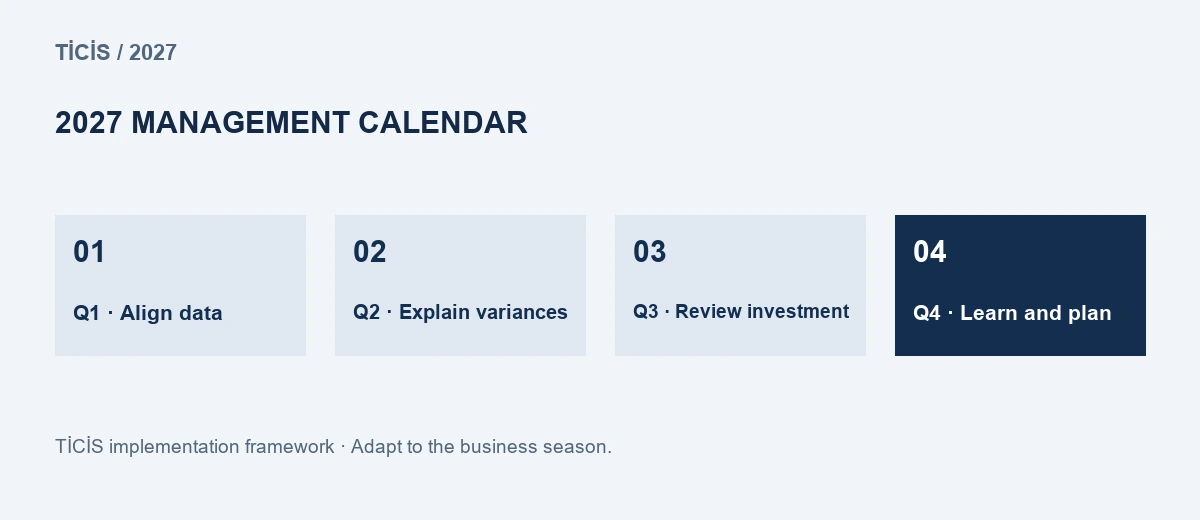
The purpose of the first quarter is to relate budget assumptions to actual records. Sales, purchasing, production, and finance teams should use the same initial data. One team talking about the order amount, another talking about invoiced sales, and the third talking about collections can disrupt decisions while seemingly creating an agreement. Common definitions are written; It is determined which data will be updated and when on a product, customer and project basis. TİCİS sees this stage as a decision infrastructure, not a reporting burden.
In the second quarter, initial results are compared to the budget. It is distinguished whether the difference is due to price, quantity, exchange rate, cost or timing. When a deviation is observed, intervention is made based on the cause rather than correcting the entire budget at a single rate. If collections are delayed, increasing the sales target may not be the solution. If the bottleneck is production, increasing the advertising budget may increase the delivery problem. The outcome of the management meeting should not be just a statement, but a decision with a clear responsibility and date.
Investment and capacity decisions are reviewed again in the third quarter. Are the gains in the first half permanent or a one-off customer or price impact? Is order visibility sufficient for new capacity? Is the supplier and personnel plan ready? The answers to these questions determine the scale of the investment. If the optimistic scenario comes true, controlled growth can be accelerated; If certain conditions are not met, a part of the investment may be postponed. Resilience is not failure, but resource management under uncertainty.
While preparing the next year's budget in the last quarter, the accuracy of previous assumptions is evaluated. Which indicators gave early warning and which produced unnecessary noise? In which customer segment did the contribution increase, in which project was the cash delayed? This evaluation is not done to blame people, but to ensure that the model learns. The source of forecast error may be a lack of data, incorrect assumptions, or an implementation problem. Each requires a different solution.
The TİCİS recommendation is to use a one-page summary in management meetings that focuses on a few critical decisions at most. The detailed report is available in the background; The summary shows the changed assumption, expected impact, proposed action, and decision date. Colors should be based on real criteria and should not be used just to attract attention. If what to do when an indicator is red is predefined, it becomes an indicator management tool. Otherwise, it remains a screen that looks nice but does not produce any decisions.
19. TİCİS's optimistic but measured expectations for 2027
TİCİS evaluates that the strongest opportunity in preparation for 2027 lies in the areas of enterprises' own control. Better recording, shorter collection, less wastage, more accurate pricing and more selective investment; It can be started without waiting for all external conditions to turn positive. If macroeconomic stability strengthens, the impact of these preparations may become more visible. Our optimism is not based on the claim that every business will achieve the same outcome at the same time. It is based on the prepared business's capacity to take advantage of evolving conditions.
On the financing side, our expectation is that the possible recovery can be used most efficiently by businesses with transparent cash flow and realistic investment plans. On the sales side, our expectation is that companies that understand customer needs correctly and provide reliable service will be able to better demonstrate their values other than price. On the production side, our expectation is that using existing capacity efficiently is as important as major investment in many businesses. These are not official estimates, but rather conditional assessments that TİCİS developed for this report.
Artificial intelligence and automation are important tools in this context. However, the value of technology is not that it eliminates the purpose and responsibility of work; It helps people make faster and more consistent decisions. The measure of success is not the name of the tool used, but the verified time, quality and cost savings. The TİCİS proposal is for applications that start small, measure the results, and grow while maintaining control. This approach transforms technology investment from a fashion choice into a business decision.
After all, preparing for 2027 cannot be reduced to correctly predicting a single exchange rate, interest rate or growth figure. It is necessary to produce decisions that can work under more than one condition, monitor the realizations and adapt when necessary. The tables, examples, and interactive tools of this report should be used in conjunction with this purpose. The real value emerges when the business places its own data. TİCİS's proposal is to establish a management system that is more prepared for the future, rather than assuming that it knows the future for sure.
20. Measurement discipline: connecting the indicator to the decision rule
For a management indicator to be useful, its definition, source, update frequency and responsible person must be clear. For example, whether all sales or only credit sales are used in the collection day calculation changes the result. Comparing month-end receivables to annual sales can be misleading in a seasonal business. Management should maintain the same definition across periods, disclosing historical comparison when the definition changes. If it is written down which system the data came from and who verified it, the report is no longer dependent on the individual.
Threshold values are also determined by business. The same stock day or the same debt ratio cannot be considered safe for every company. Seasonality of the business, durability of the product, customer contracts and lead time are different. The threshold should be associated with the cash needs that the business can carry, as well as historical data. For example, the resource impact of a one-week increase in collection period is calculated; compared to the existing cash buffer. Thus, a colored warning makes real economic sense.
Changing the indicator and making the decision automatically are not the same thing. A sales decline may result from loss of demand, delivery delay, or temporary out-of-stock of the product. The same figure requires three different interventions. The TİCİS recommendation is to conduct a brief cause review and responsible assessment after the warning. Automated system can speed up data; The context of the decision must be preserved. Especially in long-term decisions such as investment and credit, transactions should not be based on a single indicator.
The data age should be visible on the management screen. Showing current sales and stock information from three months ago at the same time may create misleading integrity. Missing data should not be treated as zero; should be marked as unknown. Zero sales is a real situation, no data coming in is another. Maintaining this distinction is more valuable than a system that appears very advanced but produces incorrect results. Data completeness should also be included in the checklist.
Finally, a brief record of each major decision should be kept: assumption used, expected outcome, responsible, review date, and actual outcome. These records are the learning source for the next budget. It is also risky to repeat a successful decision without understanding why it was successful; The result that occurs by chance can be considered a success of the method. The discipline proposed by TİCİS transforms the experience of the enterprise into corporate knowledge. Thus, the 2027 report becomes a management framework used throughout the year, rather than a text that is read once and closed.